
- Home
- Agatha Christie
The Man in the Brown Suit Page 4
The Man in the Brown Suit Read online
Page 4
I thanked him and apologized for my methods.
“Don’t mention it. I rather like cheek—from a pretty girl. By the way, you said two minutes and you’ve been three, allowing for interruptions. For a woman, that’s quite remarkable! Must be your scientific training.”
I was in the street again, breathing hard as though I had been running. I found Lord Nasby rather wearing as a new acquaintance.
Six
I went home with a feeling of exultation. My scheme had succeeded far better than I could possibly have hoped. Lord Nasby had been positively genial. It only now remained for me to “make good,” as he expressed it. Once locked in my own room, I took out my precious piece of paper and studied it attentively. Here was the clue to the mystery.
To begin with, what did the figures represent? There were five of them, and a dot after the first two. “Seventeen—one hundred and twenty two,” I murmured.
That did not seem to lead to anything.
Next I added them up. That is often done in works of fiction and leads to surprising deductions.
“One and seven make eight and one is nine and two are eleven and two are thirteen!”
Thirteen! Fateful number! Was this a warning to me to leave the whole thing alone? Very possibly. Anyway, except as a warning, it seemed to be singularly useless. I declined to believe that any conspirator would take that way of writing thirteen in real life. If he meant thirteen, he would write thirteen. “13”—like that.
There was a space between the one and the two. I accordingly subtracted twenty-two from a hundred and seventy-one. The result was a hundred and fifty-nine. I did it again and made it a hundred and forty-nine. These arithmetical exercises were doubtless excellent practice, but as regarded the solution of the mystery, they seemed totally ineffectual. I left arithmetic alone, not attempting fancy division or multiplication, and went on to the words.
Kilmorden Castle. That was something definite. A place. Probably the cradle of an aristocratic family. (Missing heir? Claimant to title?) Or possibly a picturesque ruin. (Buried treasure?)
Yes, on the whole I inclined to the theory of buried treasure. Figures always go with buried treasure. One pace to the right, seven paces to the left, dig one foot, descend twenty-two steps. That sort of idea. I could work out that later. The thing was to get to Kilmorden Castle as quickly as possible.
I made a strategic sally from my room, and returned laden with books of reference. Who’s Who, Whitaker, a Gazetteer, a History of Scotch Ancestral Homes, and Somebody or other’s British Isles.
Time passed. I searched diligently, but with growing annoyance. Finally, I shut the last book with a bang. There appeared to be no such place as Kilmorden Castle.
Here was an unexpected check. There must be such a place. Why should anyone invent a name like that and write it down on a piece of paper? Absurd!
Another idea occurred to me. Possibly it was a castellated abomination in the suburbs with a high-sounding name invented by its owner. But if so, it was going to be extraordinarily hard to find. I sat back gloomily on my heels (I always sit on the floor to do anything really important) and wondered how on earth I was to set about it.
Was there any other line I could follow? I reflected earnestly and then sprang to my feet delightedly. Of course! I must visit the “scene of the crime.” Always done by the best sleuths! And no matter how long afterwards it may be they always find something that the police have overlooked. My course was clear. I must go to Marlow.
But how was I to get into the house? I discarded several adventurous methods, and plumped for stern simplicity. The house had been to let—presumably was still to let. I would be a prospective tenant.
I also decided on attacking the local house agents, as having fewer houses on their books.
Here, however, I reckoned without my host. A pleasant clerk produced particulars of about half a dozen desirable properties. It took me all my ingenuity to find objections to them. In the end I feared I had drawn a blank.
“And you’ve really nothing else?” I asked, gazing pathetically into the clerk’s eyes. “Something right on the river, and with a fair amount of garden and a small lodge.” I added, summing up the main points of the Mill House, as I had gathered them from the papers.
“Well, of course, there’s Sir Eustace Pedler’s place,” said the man doubtfully. “The Mill House, you know.”
“Not—not where—” I faltered. (Really, faltering is getting to be my strong point.)
“That’s it! Where the murder took place. But perhaps you wouldn’t like—”
“Oh, I don’t think I should mind,” I said with an appearance of rallying. I felt my bona fides was now quite established. “And perhaps I might get it cheap—in the circumstances.”
A master touch that, I thought.
“Well, it’s possible. There’s no pretending that it will be easy to let now—servants and all that, you know. If you like the place after you’ve seen it, I should advise you to make an offer. Shall I write you out an order?”
“If you please.”
A quarter of an hour later I was at the lodge of the Mill House. In answer to my knock, the door flew open and a tall middle-aged woman literally bounced out.
“Nobody can go into the house, do you hear that? Fairly sick of you reporters, I am. Sir Eustace’s orders are—”
“I understood the house was to let,” I said freezingly, holding out my order. “Of course, if it’s already taken—”
“Oh, I’m sure I beg your pardon, miss. I’ve been fairly pestered with these newspaper people. Not a minute’s peace. No, the house isn’t let—nor likely to be now.”
“Are the drains wrong?” I asked in an anxious whisper.
“Oh, Lord, miss, the drains is all right! But surely you’ve heard about that foreign lady as was done to death here?”
“I believe I did read something about it in the papers,” I said carelessly.
My indifference piqued the good woman. If I had betrayed any interest, she would probably have closed up like an oyster. As it was she positively bridled.
“I should say you did, miss! It’s been in all the newspapers. The Daily Budget’s out still to catch the man who did it. It seems, according to them, as our police are no good at all. Well I hope they’ll get him—although a nice-looking fellow he was and no mistake. A kind of soldierly look about him—ah, well, I dare say he’d been wounded in the war, and sometimes they go a bit queer aftwards; my sister’s boy did. Perhaps she’d used him bad—they’re a bad lot, those foreigners. Though she was a fine-looking woman. Stood there where you’re standing now.”
“Was she dark or fair?” I ventured. “You can’t tell from these newspaper portraits.”
“Dark hair, and a very white face—too white for nature, I thought—had her lips reddened something cruel. I don’t like to see it—a little powder now and then is quite another thing.”
We were conversing like old friends now. I put another question.
“Did she seem nervous or upset at all?”
“Not a bit. She was smiling to herself, quiet like, as though she was amused at something. That’s why you could have knocked me down with a feather when, the next afternoon, those people came running out calling for the police and saying there’d been murder done. I shall never get over it, and as for setting foot in that house after dark I wouldn’t do it, not if it was ever so. Why, I wouldn’t even stay here at the lodge, if Sir Eustace hadn’t been down on his bended knees to me.”
“I thought Sir Eustace Pedler was at Cannes?”
“So he was, miss. He came back to England when he heard the news, and, as to the bended knees, that was a figure of speech, his secretary, Mr. Pagett, having offered us double pay to stay on, and, as my John says, money is money nowadays.”
I concurred heartily with John’s by no means original remarks.
“The young man now,” said Mrs. James, reverting suddenly to a former point in the conversation. “He was u
pset. His eyes, light eyes, they were, I noticed them particular, was all shining. Excited, I thought. But I never dreamt of anything being wrong. Not even when he came out again looking all queer.”
“How long was he in the house?”
“Oh, not long, a matter of five minutes maybe.”
“How tall was he, do you think? About six foot?”
“I should say so maybe.”
“He was clean-shaven, you say?”
“Yes, miss—not even one of these toothbrush moustaches.”
“Was his chin at all shiny?” I asked on a sudden impulse.
Mrs. James stared at me with awe.
“Well, now you come to mention it, miss, it was. However did you know?”
“It’s a curious thing, but murderers often have shiny chins,” I explained wildly.
Mrs. James accepted the statement in all good faith.
“Really, now, miss. I never heard that before.”
“You didn’t notice what kind of head he had, I suppose?”
“Just the ordinary kind, miss. I’ll fetch you the keys, shall I?”
I accepted them, and went on my way to the Mill House. My reconstructions so far I considered good. All along I had realized that the differences between the man Mrs. James had described and my Tube “doctor” were those of nonessentials. An overcoat, a beard, gold-rimmed eyeglasses. The “doctor” had appeared middle-aged, but I remembered that he had stooped over the body like a comparatively young man. There had been a suppleness which told of young joints.
The victim of the accident (the Moth Ball man, as I called him to myself ) and the foreign woman, Mrs. de Castina, or whatever her real name was, had had an assignation to meet at the Mill House. That was how I pieced the thing together. Either because they feared they were being watched or for some other reason, they chose the rather ingenious method of both getting an order to view the same house. Thus their meeting there might have the appearance of pure chance.
That the Moth Ball man had suddenly caught sight of the “doctor,” and that the meeting was totally unexpected and alarming to him, was another fact of which I was fairly sure. What had happened next? The “doctor” had removed his disguise and followed the woman to Marlow. But it was possible that had he removed it rather hastily traces of spirit gum might still linger on his chin. Hence my question to Mrs. James.
Whilst occupied with my thoughts I had arrived at the low old-fashioned door of the Mill House. Unlocking it with the key, I passed inside. The hall was low and dark, the place smelt forlorn and mildewy. In spite of myself, I shivered. Did the woman who had come here “smiling to herself” a few days ago feel no chill of premonition as she entered this house? I wondered. Did the smile fade from her lips, and did a nameless dread close round her heart? Or had she gone upstairs, smiling still, unconscious of the doom that was so soon to overtake her? My heart beat a little faster. Was the house really empty? Was doom waiting for me in it also? For the first time, I understood the meaning of the much-used word, “atmosphere.” There was an atmosphere in this house, an atmosphere of cruelty, of menace, of evil.
Seven
Shaking off the feelings that oppressed me, I went quickly upstairs. I had no difficulty in finding the room of the tragedy. On the day the body was discovered it had rained heavily, and large muddy boots had trampled the uncarpeted floor in every direction. I wondered if the murderer had left any footmarks the previous day. It was likely that the police would be reticent on the subject if he had, but on consideration I decided it was unlikely. The weather had been fine and dry.
There was nothing of interest about the room. It was almost square with two big bay windows, plain white walls and a bare floor, the boards being stained round the edges where the carpet had ceased. I searched it carefully, but there was not so much as a pin lying about. The gifted young detective did not seem likely to discover a neglected clue.
I had brought with me a pencil and notebook. There did not seem much to note, but I duly dotted down a brief sketch of the room to cover my disappointment at the failing of my quest. As I was in the act of returning the pencil to my bag, it slipped from my fingers and rolled along the floor.
The Mill House was really old, and the floors were very uneven. The pencil rolled steadily, with increasing momentum, until it came to rest under one of the windows. In the recess of each window there was a broad window seat, underneath which there was a cupboard. My pencil was lying right against the cupboard door. The cupboard was shut, but it suddenly occurred to me that if it had been open my pencil would have rolled inside. I opened the door, and my pencil immediately rolled in and sheltered modestly in the farthest corner. I retrieved it, noting as I did so that owing to lack of light and the peculiar formation of the cupboard one could not see it, but had to feel for it. Apart from my pencil the cupboard was empty, but being thorough by nature I tried the one under the opposite window.
At first sight, it looked as though that also was empty, but I grubbed about perseveringly, and was rewarded by feeling my hand close on a hard paper cylinder which lay in a sort of trough, or depression, in the far corner of the cupboard. As soon as I had it in my hand, I knew what it was. A roll of Kodak films. Here was a find!
I realized, of course, that these films might very well be an old roll belonging to Sir Eustace Pedler which had rolled in here and had not been found when the cupboard was emptied. But I did not think so. The red paper was far too fresh-looking. It was just as dusty as it would have been had it lain there for two or three days—that is to say, since the murder. Had it been there for any length of time, it would have been thickly-coated.
Who had dropped it? The woman or the man? I remembered that the contents of her handbag had appeared to be intact. If it had been jerked open in the struggle and the roll of films had fallen out, surely some of the loose money would have been scattered about also? No, it was not the woman who had dropped the films.
I sniffed suddenly and suspiciously. Was the smell of mothballs becoming an obsession with me? I could swear that the roll of films smelt of it also. I held them under my nose. They had, as usual, a strong smell of their own, but apart from that I could clearly detect the odour I disliked so much. I soon found the cause. A minute thread of cloth had caught on a rough edge of the centre wood, and that shred was strongly impregnated with mothballs. At some time or another the films had been carried in the overcoat pocket of the man who was killed in the Tube. Was it he who had dropped them here? Hardly. His movements were all accounted for.
No, it was the other man, the “doctor.” He had taken the films when he had taken the paper. It was he who had dropped them here during his struggle with the woman.
I had got my clue! I would have the roll developed, and then I would have further developments to work upon.
Very elated, I left the house, returned the keys to Mrs. James and made my way as quickly as possible to the station. On the way back to town, I took out my paper and studied it afresh. Suddenly the figures took on a new significance. Suppose they were a date? 17 1 22. The 17th of January, 1922. Surely that must be it! Idiot that I was not to have thought of it before. But in that case I must find out the whereabouts of Kilmorden Castle, for today was actually the 14th. Three days. Little enough—almost hopeless when one had no idea of where to look!
It was too late to hand in my roll today. I had to hurry home to Kensington so as not to be late for dinner. It occurred to me that there was an easy way of verifying whether some of my conclusions were correct. I asked Mr. Flemming whether there had been a camera amongst the dead man’s belongings. I knew that he had taken an interest in the case and was conversant with all the details.
To my surprise and annoyance he replied that there had been no camera. All Carton’s effects had been gone over very carefully in the hopes of finding something that might throw light upon his state of mind. He was positive that there had been no photographic apparatus of any kind.
That was rather a setback to my
theory. If he had no camera, why should he be carrying a roll of films?
I set out early next morning to take my precious roll to be developed. I was so fussy that I went all the way to Regent Street to the big Kodak place. I handed it in and asked for a print of each film. The man finished stacking together a heap of films packed in yellow tin cylinders for the tropics, and picked up my roll.
He looked at me.
“You’ve made a mistake, I think,” he said, smiling.
“Oh, no,” I said. “I’m sure I haven’t.”
“You’ve given me the wrong roll. This is an unexposed one.”
I walked out with what dignity I could muster. I dare say it is good for one now and again to realize what an idiot one can be! But nobody relishes the process.
And then, just as I was passing one of the big shipping offices, I came to a sudden halt. In the window was a beautiful model of one of the company’s boats, and it was labelled “Kenilworth Castle.” A wild idea shot through my brain. I pushed the door open and went in. I went up to the counter and in a faltering voice (genuine this time!) I murmured:
“Kilmorden Castle?”
“On the 17th from Southampton. Cape Town? First or second class?”
“How much is it?”
“First class, eighty-seven pounds—”
I interrupted him. The coincidence was too much for me. Exactly the amount of my legacy! I would put all my eggs in one basket.
“First class,” I said.
I was now definitely committed to the adventure.
Eight
(Extracts from the diary of Sir Eustace Pedler, MP)
It is an extraordinary thing that I never seem to get any peace. I am a man who likes a quiet life. I like my Club, my rubber of Bridge, a well-cooked meal, a sound wine. I like England in the summer, and the Riviera in the winter. I have no desire to participate in sensational happenings. Sometimes, in front of a good fire, I do not object to reading about them in the newspaper. But that is as far as I am willing to go. My object in life is to be thoroughly comfortable. I have devoted a certain amount of thought, and a considerable amount of money, to further that end. But I cannot say that I always succeed. If things do not actually happen to me, they happen round me, and frequently, in spite of myself, I become involved. I hate being involved.
 Murder in the Mews
 Postern of Fate
 The Regatta Mystery and Other Stories
 Sad Cypress
 Why Didn't They Ask Evans?
 After the Funeral
 And Then There Were None
 The Witness for the Prosecution
 Murder on the Orient Express
 The Seven Dials Mystery
 Hercule Poirot: The Complete Short Stories
 The Mysterious Affair at Styles
 Sleeping Murder
 Hickory Dickory Dock
 The Moving Finger
 The Mirror Crack'd From Side to Side
 Ordeal by Innocence
 Mrs. McGinty's Dead
 Problem at Pollensa Bay and Other Stories
 Death Comes as the End
 Endless Night
 Parker Pyne Investigates
 Poirot's Early Cases: 18 Hercule Poirot Mysteries
 Murder Is Easy
 An Autobiography
 One, Two, Buckle My Shoe
 A Pocket Full of Rye
 The Mysterious Mr. Quin
 The Mystery of the Blue Train
 Hercule Poirot's Christmas: A Hercule Poirot Mystery
 Cards on the Table (SB)
 Three Act Tragedy
 The Secret Adversary
 The Body in the Library
 The Pale Horse
 While the Light Lasts
 The Golden Ball and Other Stories
 Double Sin and Other Stories
 The Secret of Chimneys
 Five Little Pigs
 Murder in Mesopotamia: A Hercule Poirot Mystery
 The Mousetrap and Other Plays
 Lord Edgware Dies
 The Hound of Death
 The Murder on the Links
 A Caribbean Mystery
 Peril at End House: A Hercule Poirot Mystery
 The Thirteen Problems
 By the Pricking of My Thumbs
 Mrs McGinty's Dead / the Labours of Hercules (Agatha Christie Collected Works)
 Appointment With Death
 Murder Is Announced
 The Big Four
 Three Blind Mice and Other Stories
 Hercule Poirot- the Complete Short Stories
 Passenger to Frankfurt
 They Do It With Mirrors
 Poirot Investigates
 The Coming of Mr. Quin: A Short Story
 4:50 From Paddington
 The Last Seance
 Dead Man's Folly
 The Adventure of the Christmas Pudding
 The A.B.C. Murders
 Death in the Clouds
 Towards Zero
 The Listerdale Mystery and Eleven Other Stories
 Hallowe'en Party
 Murder at the Vicarage
 Cards on the Table
 Death on the Nile
 Curtain
 Partners in Crime
 The Listerdale Mystery / the Clocks (Agatha Christie Collected Works)
 Taken at the Flood
 Dumb Witness
 The Complete Tommy and Tuppence
 Problem at Pollensa Bay
 Cat Among the Pigeons
 At Bertram's Hotel
 Nemesis
 Miss Marple's Final Cases
 The Hollow
 Midwinter Murder
 They Came to Baghdad
 Third Girl
 Destination Unknown
 Hercule Poirot and the Greenshore Folly
 Postern of Fate tat-5
 Midsummer Mysteries
 Poirot's Early Cases hp-38
 Sparkling Cyanide
 Star over Bethlehem
 Black Coffee hp-7
 Hercule Poirot's Casebook (hercule poirot)
 Murder in Mesopotamia hp-14
 A Pocket Full of Rye: A Miss Marple Mystery (Miss Marple Mysteries)
 The Listerdale Mystery
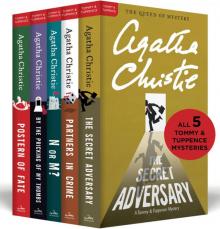 The Complete Tommy & Tuppence Collection
 Lord Edgware Dies hp-8
 Death in the Clouds hp-12
 Short Stories
 Third Girl hp-37
 Why Didn't They Ask Evans
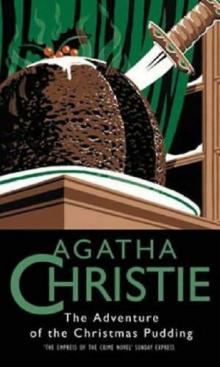 Adventure of the Christmas Pudding and other stories
 Cards on the Table hp-15
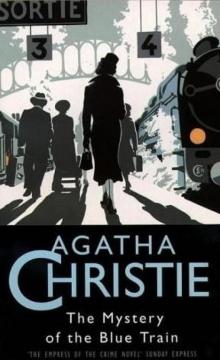 The Mystery of the Blue Train hp-6
 After the Funeral hp-29
 Poirot Investigates hp-3
 Murder on the Links hp-2
 The Mysterious Mr Quin
 Curtain hp-39
 Hercule Poirot's Christmas hp-19
 Partners in Crime tat-2
 The Clocks hp-36
 Murder, She Said
 The Clocks
 The Hollow hp-24
 Appointment with Death hp-21
 Murder in the mews hp-18
 The Murder Of Roger Ackroyd hp-4
 Dumb Witness hp-16
 The Sittaford Mystery
 Mrs McGinty's Dead
 Evil Under the Sun
 The A.B.C. Murders hp-12
 The Murder at the Vicarage mm-1
 The Body in the Library mm-3
 Miss Marple and Mystery
 Sleeping Murder mm-14
 By the Pricking of My Thumbs tat-4
 A Pocket Full of Rye mm-7
 Hickory Dickory Dock: A Hercule Poirot Mystery
 The Big Four hp-5
 The Labours of Hercules hp-26
 The Complete Miss Marple Collection
 The Labours of Hercules
 4.50 From Paddington
 A Murder Is Announced mm-5
 Agahta Christie: An autobiography
 Hallowe'en Party hp-36
 Black Coffee
 The Mysterious Affair at Styles hp-1
 Three-Act Tragedy
 Best detective short stories
 Three Blind Mice
 Nemesis mm-11
 The Mirror Crack'd from Side to Side mm-8
 The ABC Murders
 Poirot's Early Cases
 The Unexpected Guest
 A Caribbean Mystery - Miss Marple 09
 The Murder of Roger Ackroyd
 Elephants Can Remember hp-39
 The Mirror Crack'd: from Side to Side
 Sad Cypress hp-21
 Peril at End House
 Elephants Can Remember
 Best detective stories of Agatha Christie
 Hercule Poirot's Christmas
 The Body In The Library - Miss Marple 02
 Evil Under the Sun hp-25
 The Capture of Cerberus
 The Hound of Death and Other Stories
 The Thirteen Problems (miss marple)
 The Thirteen Problems-The Tuesday Night Club
 Spider's Web
 At Bertram's Hotel mm-12
 The Murder at the Vicarage (Agatha Christie Mysteries Collection)
 A Caribbean Mystery (miss marple)
 A Murder Is Announced
 Clues to Christie
 The Moving Finger mm-3
 The Harlequin Tea Set and Other Stories
 Murder on the Links
 The Murder at the Vicarage
 N or M tat-3
 The Secret Adversary tat-1
 The Burden
 Mrs McGinty's Dead hp-28
 Dead Man's Folly hp-31
 Peril at End House hp-8
 Complete Short Stories Of Miss Marple mm-16
 Curtain: Poirot's Last Case
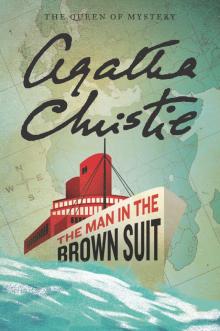 The Man in the Brown Suit
 They Do It With Mirrors mm-6