
- Home
- Agatha Christie
Dumb Witness Page 4
Dumb Witness Read online
Page 4
So much was this the case that the least interruption of the rhythm attracted one’s attention.
I was sitting by the window, looking out at the passing traffic. I had recently returned from Argentina and there was something particularly exciting to me in being once more in the roar of London.
Turning my head, I said with a smile:
“Poirot, I—the humble Watson—am going to hazard a deduction.”
“Enchanted, my friend. What is it?”
I struck an attitude and said pompously:
“You have received this morning one letter of particular interest!”
“You are indeed the Sherlock Holmes! Yes, you are perfectly right.”
I laughed.
“You see, I know your methods, Poirot. If you read a letter through twice it must mean that it is of special interest.”
“You shall judge for yourself, Hastings.”
With a smile my friend tendered me the letter in question.
I took it with no little interest, but immediately made a slight grimace. It was written in one of those old-fashioned spidery handwritings, and it was, moreover, crossed on two pages.
“Must I read this, Poirot?” I complained.
“Ah, no, there is no compulsion. Assuredly not.”
“Can’t you tell me what it says?”
“I would prefer you to form your own judgement. But do not trouble if it bores you.”
“No, no, I want to know what it’s all about,” I protested.
My friend remarked drily:
“You can hardly do that. In effect, the letter says nothing at all.”
Taking this as an exaggeration I plunged without more ado into the letter.
M. Hercule Poirot.
Dear Sir,
After much doubt and indecision, I am writing (the last word was crossed out and the letter went on) I am emboldened to write to you in the hope that you may be able to assist me in a matter of a strictly private nature. (The words strictly private were underlined three times.) I may say that your name is not unknown to me. It was mentioned to me by a Miss Fox of Exeter, and although Miss Fox was not herself acquainted with you, she mentioned that her brother-in-law’s sister (whose name I cannot, I am sorry to say, recall) had spoken of your kindness and discretion in the highest terms (highest terms underlined once). I did not inquire, of course, as to the nature (nature underlined) of the inquiry you had conducted on her behalf, but I understood from Miss Fox that it was of a painful and confidential nature (last four words underlined heavily).
I broke off my difficult task of spelling out the spidery words.
“Poirot,” I said. “Must I go on? Does she ever get to the point?”
“Continue, my friend. Patience.”
“Patience!” I grumbled. “It’s exactly as though a spider had got into an inkpot and was walking over a sheet of notepaper! I remember my Great-Aunt Mary’s writing used to be much the same!”
Once more I plunged into the epistle.
In my present dilemma, it occurs to me that you might undertake the necessary investigations on my behalf. The matter is such, as you will readily understand, as calls for the utmost discretion and I may, in fact—and I need hardly say how sincerely I hope and pray (pray underlined twice) that this may be the case—I may, in fact, be completely mistaken. One is apt sometimes to attribute too much significance to facts capable of a natural explanation.
“I haven’t left out a sheet?” I murmured in some perplexity.
Poirot chuckled.
“No, no.”
“Because this doesn’t seem to make sense. What is it she is talking about?”
“Continuez toujours.”
“The matter is such, as you will readily understand—No, I’d got past that. Oh! here we are. In the circumstances as I am sure you will be the first to appreciate, it is quite impossible for me to consult anyone in Market Basing (I glanced back at the heading of the letter. Littlegreen House, Market Basing, Berks), but at the same time you will naturally understand that I feel uneasy (uneasy underlined). During the last few days I have reproached myself with being unduly fanciful (fanciful underlined three times) but have only felt increasingly perturbed. I may be attaching undue importance to what is, after all, a trifle (trifle underlined twice) but my uneasiness remains. I feel definitely that my mind must be set at rest on the matter. It is actually preying on my mind and affecting my health, and naturally I am in a difficult position as I can say nothing to anyone (nothing to anyone underlined with heavy lines). In your wisdom you may say, of course, that the whole thing is nothing but a mare’s nest. The facts may be capable of a perfectly innocent explanation (innocent underlined). Nevertheless, however trivial it may seem, ever since the incident of the dog’s ball, I have felt increasingly doubtful and alarmed. I should therefore welcome your views and counsel on the matter. It would, I feel sure, take a great weight off my mind. Perhaps you would kindly let me know what your fees are and what you advise me to do in the matter?
I must impress on you again that nobody here knows anything at all. The facts are, I know, very trivial and unimportant, but my health is not too good and my nerves (nerves underlined three times) are not what they used to be. Worry of this kind, I am convinced, is very bad for me, and the more I think over the matter, the more I am convinced that I was quite right and no mistake was possible. Of course, I shall not dream of saying anything (underlined) to anyone (underlined).
Hoping to have your advice in the matter at an early date.
I remain, Yours faithfully,
Emily Arundell.”
I turned the letter over and scanned each page closely. “But, Poirot,” I expostulated, “what is it all about?”
My friend shrugged his shoulders.
“What indeed?”
I tapped the sheets with some impatience.
“What a woman! Why can’t Mrs.—or Miss Arundell—”
“Miss, I think. It is typically the letter of a spinster.”
“Yes,” I said. “A real, fussy old maid. Why can’t she say what she’s talking about?”
Poirot sighed.
“As you say—a regrettable failure to employ order and method in the mental processes, and without order and method, Hastings—”
“Quite so,” I interrupted hastily. “Little grey cells practically nonexistent.”
“I would not say that, my friend.”
“I would. What’s the sense of writing a letter like that?”
“Very little—that is true,” Poirot admitted.
“A long rigmarole all about nothing,” I went on. “Probably some upset to her fat lapdog—an asthmatic pug or a yapping Pekinese!” I looked at my friend curiously. “And yet you read that letter through twice. I do not understand you, Poirot.”
Poirot smiled.
“You, Hastings, you would have put it straight in the wastepaper basket?”
“I’m afraid I should.” I frowned down on the letter. “I suppose I’m being dense, as usual, but I can’t see anything of interest in this letter!”
“Yet there is one point in it of great interest—a point that struck me at once.”
“Wait,” I cried. “Don’t tell me. Let me see if I can’t discover it for myself.”
It was childish of me, perhaps. I examined the letter very thoroughly. Then I shook my head.
“No, I don’t see it. The old lady’s got the wind up, I realize that—but then, old ladies often do! It may be about nothing—it may conceivably be about something, but I don’t see that you can tell that that is so. Unless your instinct—”
Poirot raised an offended hand.
“Instinct! You know how I dislike that word. ‘Something seems to tell me’—that is what you infer. Jamais de la vie! Me, I reason. I employ the little grey cells. There is one interesting point about that letter which you have overlooked utterly, Hastings.”
“Oh, well,” I said wearily. “I’ll buy it.”
“Buy it
? Buy what?”
“An expression. Meaning that I will permit you to enjoy yourself by telling me just where I have been a fool.”
“Not a fool, Hastings, merely unobservant.”
“Well, out with it. What’s the interesting point? I suppose, like the ‘incident of the dog’s ball,’ the point is that there is no interesting point!”
Poirot disregarded this sally on my part. He said quietly and calmly:
“The interesting point is the date.”
“The date?”
I picked up the letter. On the top left-hand corner was written April 17th.
“Yes,” I said slowly. “That is odd. April 17th.”
“And we are today June 28th. C’est curieux, n’est ce pas? Over two months ago.”
I shook my head doubtfully.
“It probably doesn’t mean anything. A slip. She meant to put June and wrote April instead.”
“Even then it would be ten or eleven days old—an odd fact. But actually you are in error. Look at the colour of the ink. That letter was written more than ten or eleven days ago. No, April 17th is the date assuredly. But why was the letter not sent?”
I shrugged my shoulders.
“That’s easy. The old pussy changed her mind.”
“Then why did she not destroy the letter? Why keep it over two months and post it now?”
I had to admit that that was harder to answer. In fact I couldn’t think of a really satisfactory answer. I merely shook my head and said nothing.
Poirot nodded.
“You see—it is a point! Yes, decidedly a curious point.”
“You are answering the letter?” I asked.
“Oui, mon ami.”
The room was silent except for the scratching of Poirot’s pen. It was a hot, airless morning. A smell of dust and tar came in through the window.
Poirot rose from his desk, the completed letter in his hand. He opened a drawer and drew out a little square box. From this he took out a stamp. Moistening this with a little sponge he prepared to affix it to the letter.
Then suddenly he paused, stamp in hand, shaking his head with vigour.
“Non!” he exclaimed. “That is the wrong thing I do.” He tore the letter across and threw it into the wastepaper basket.
“Not so must we tackle this matter! We will go, my friend.”
“You mean to go down to Market Basing?”
“Precisely. Why not? Does not one stifle in London today? Would not the country air be agreeable?”
“Well, if you put it like that,” I said. “Shall we go in the car?”
I had acquired a secondhand Austin.
“Excellent. A very pleasant day for motoring. One will hardly need the muffler. A light overcoat, a silk scarf—”
“My dear fellow, you’re not going to the North Pole!” I protested.
“One must be careful of catching the chill,” said Poirot sententiously.
“On a day like this?”
Disregarding my protests, Poirot proceeded to don a fawn-coloured overcoat and wrap his neck up with a white silk handkerchief. Having carefully placed the wetted stamp face downwards on the blotting paper to dry, we left the room together.
Six
WE GO TO LITTLEGREEN HOUSE
I don’t know what Poirot felt like in his coat and muffler but I myself felt roasted before we got out of London. An open car in traffic is far from being a refreshing place on a hot summer’s day.
Once we were outside London, however, and getting a bit of pace on the Great West Road my spirits rose.
Our drive took us about an hour and a half, and it was close upon twelve o’clock when we came into the little town of Market Basing. Originally on the main road, a modern bypass now left it some three miles to the north of the main stream of traffic and in consequence it had kept an air of old-fashioned dignity and quietude about it. Its one wide street and ample market square seemed to say, “I was a place of importance once and to any person of sense and breeding I am still the same. Let this modern speeding world dash along their newfangled road; I was built to endure in a day when solidarity and beauty went hand in hand.”
There was a parking area in the middle of the big square, though there were only a few cars occupying it. I duly parked the Austin, Poirot divested himself of his superfluous garments, assured himself that his moustaches were in their proper condition of symmetrical flamboyance and we were then ready to proceed.
For once in a way our first tentative inquiry did not meet with the usual response, “Sorry, but I’m a stranger in these parts.” It would seem indeed probable that there were no strangers in Market Basing! It had that effect! Already, I felt, Poirot and myself (and especially Poirot) were somewhat noticeable. We tended to stick out from the mellow background of an English market town secure in its traditions.
“Littlegreen House?” The man, a burly, ox-eyed fellow, looked us over thoughtfully. “You go straight up the High Street and you can’t miss it. On your left. There’s no name on the gate, but it’s the first big house after the bank.” He repeated again, “You can’t miss it.”
His eyes followed us as we started on our course.
“Dear me,” I complained. “There is something about this place that makes me feel extremely conspicuous. As for you, Poirot, you look positively exotic.”
“You think it is noticed that I am a foreigner—yes?”
“The fact cries aloud to heaven,” I assured him.
“And yet my clothes are made by an English tailor,” mused Poirot.
“Clothes are not everything,” I said. “It cannot be denied, Poirot, that you have a noticeable personality. I have often wondered that it has not hindered you in your career.”
Poirot sighed.
“That is because you have the mistaken idea implanted in your head that a detective is necessarily a man who puts on a false beard and hides behind a pillar! The false beard, it is vieux jeu, and shadowing is only done by the lowest branch of my profession. The Hercule Poirots, my friend, need only to sit back in a chair and think.”
“Which explains why we are walking along this exceedingly hot street on an exceedingly hot morning.”
“That is very neatly replied, Hastings. For once, I admit, you have made the score off me.”
We found Littlegreen House easily enough, but a shock awaited us—a house agent’s board.
As we were staring at it, a dog’s bark attracted my attention.
The bushes were thin at that point and the dog could be easily seen. He was a wirehaired terrier, somewhat shaggy as to coat. His feet were planted wide apart, slightly to one side, and he barked with an obvious enjoyment of his own performance that showed him to be actuated by the most amiable motives.
“Good watchdog, aren’t I?” he seemed to be saying. “Don’t mind me! This is just my fun! My duty too, of course. Just have to let ’em know there’s a dog about the place! Deadly dull morning. Quite a blessing to have something to do. Coming into our place? Hope so. It’s darned dull. I could do with a little conversation.”
“Hallo, old man,” I said and shoved forward a fist.
Craning his neck through the railings he sniffed suspiciously, then gently wagged his tail, uttering a few short staccato barks.
“Not been properly introduced, of course, have to keep this up! But I see you know the proper advances to make.”
“Good old boy,” I said.
“Wuff,” said the terrier amiably.
“Well, Poirot?” I said, desisting from this conversation and turning to my friend.
There was an odd expression on his face—one that I could not quite fathom. A kind of deliberately suppressed excitement seems to describe it best.
“The Incident of the Dog’s Ball,” he murmured. “Well, at least, we have here a dog.”
“Wuff,” observed our new friend. Then he sat down, yawned widely and looked at us hopefully.
“What next?” I asked.
The dog seemed t
o be asking the same question.
“Parbleu, to Messrs—what is it—Messrs Gabler and Stretcher.”
“That does seem indicated,” I agreed.
We turned and retraced our steps, our canine acquaintance sending a few disgusted barks after us.
The premises of Messrs Gabler and Stretcher were situated in the Market Square. We entered a dim outer office where we were received by a young woman with adenoids and a lacklustre eye.
“Good morning,” said Poirot politely.
The young woman was at the moment speaking into a telephone but she indicated a chair and Poirot sat down. I found another and brought it forward.
“I couldn’t say, I’m sure,” said the young woman into the telephone vacantly. “No, I don’t know what the rates would be… Pardon? Oh, main water, I think, but, of course, I couldn’t be certain… I’m very sorry, I’m sure… No, he’s out… No, I couldn’t say… Yes, of course I’ll ask him… Yes…8135? I’m afraid I haven’t quite got it. Oh…8935…39… Oh, 5135… Yes, I’ll ask him to ring you…after six… Oh, pardon, before six… Thank you so much.”
She replaced the receiver, scribbled 5319 on the blotting pad and turned a mildly inquiring but uninterested gaze on Poirot.
Poirot began briskly.
“I observe that there is a house to be sold just on the outskirts of this town. Littlegreen House, I think is the name.”
“Pardon?”
“A house to be let or sold,” said Poirot slowly and distinctly. “Littlegreen House.”
“Oh, Littlegreen House,” said the young woman vaguely. “Littlegreen House, did you say?”
“That is what I said.”
“Littlegreen House,” said the young woman, making a tremendous mental effort. “Oh, well, I expect Mr. Gabler would know about that.”
“Can I see Mr. Gabler?”
“He’s out,” said the young woman with a kind of faint, anaemic satisfaction as of one who says, “A point to me.”
 Murder in the Mews
 Postern of Fate
 The Regatta Mystery and Other Stories
 Sad Cypress
 Why Didn't They Ask Evans?
 After the Funeral
 And Then There Were None
 The Witness for the Prosecution
 Murder on the Orient Express
 The Seven Dials Mystery
 Hercule Poirot: The Complete Short Stories
 The Mysterious Affair at Styles
 Sleeping Murder
 Hickory Dickory Dock
 The Moving Finger
 The Mirror Crack'd From Side to Side
 Ordeal by Innocence
 Mrs. McGinty's Dead
 Problem at Pollensa Bay and Other Stories
 Death Comes as the End
 Endless Night
 Parker Pyne Investigates
 Poirot's Early Cases: 18 Hercule Poirot Mysteries
 Murder Is Easy
 An Autobiography
 One, Two, Buckle My Shoe
 A Pocket Full of Rye
 The Mysterious Mr. Quin
 The Mystery of the Blue Train
 Hercule Poirot's Christmas: A Hercule Poirot Mystery
 Cards on the Table (SB)
 Three Act Tragedy
 The Secret Adversary
 The Body in the Library
 The Pale Horse
 While the Light Lasts
 The Golden Ball and Other Stories
 Double Sin and Other Stories
 The Secret of Chimneys
 Five Little Pigs
 Murder in Mesopotamia: A Hercule Poirot Mystery
 The Mousetrap and Other Plays
 Lord Edgware Dies
 The Hound of Death
 The Murder on the Links
 A Caribbean Mystery
 Peril at End House: A Hercule Poirot Mystery
 The Thirteen Problems
 By the Pricking of My Thumbs
 Mrs McGinty's Dead / the Labours of Hercules (Agatha Christie Collected Works)
 Appointment With Death
 Murder Is Announced
 The Big Four
 Three Blind Mice and Other Stories
 Hercule Poirot- the Complete Short Stories
 Passenger to Frankfurt
 They Do It With Mirrors
 Poirot Investigates
 The Coming of Mr. Quin: A Short Story
 4:50 From Paddington
 The Last Seance
 Dead Man's Folly
 The Adventure of the Christmas Pudding
 The A.B.C. Murders
 Death in the Clouds
 Towards Zero
 The Listerdale Mystery and Eleven Other Stories
 Hallowe'en Party
 Murder at the Vicarage
 Cards on the Table
 Death on the Nile
 Curtain
 Partners in Crime
 The Listerdale Mystery / the Clocks (Agatha Christie Collected Works)
 Taken at the Flood
 Dumb Witness
 The Complete Tommy and Tuppence
 Problem at Pollensa Bay
 Cat Among the Pigeons
 At Bertram's Hotel
 Nemesis
 Miss Marple's Final Cases
 The Hollow
 Midwinter Murder
 They Came to Baghdad
 Third Girl
 Destination Unknown
 Hercule Poirot and the Greenshore Folly
 Postern of Fate tat-5
 Midsummer Mysteries
 Poirot's Early Cases hp-38
 Sparkling Cyanide
 Star over Bethlehem
 Black Coffee hp-7
 Hercule Poirot's Casebook (hercule poirot)
 Murder in Mesopotamia hp-14
 A Pocket Full of Rye: A Miss Marple Mystery (Miss Marple Mysteries)
 The Listerdale Mystery
 The Complete Tommy & Tuppence Collection
 Lord Edgware Dies hp-8
 Death in the Clouds hp-12
 Short Stories
 Third Girl hp-37
 Why Didn't They Ask Evans
 Adventure of the Christmas Pudding and other stories
 Cards on the Table hp-15
 The Mystery of the Blue Train hp-6
 After the Funeral hp-29
 Poirot Investigates hp-3
 Murder on the Links hp-2
 The Mysterious Mr Quin
 Curtain hp-39
 Hercule Poirot's Christmas hp-19
 Partners in Crime tat-2
 The Clocks hp-36
 Murder, She Said
 The Clocks
 The Hollow hp-24
 Appointment with Death hp-21
 Murder in the mews hp-18
 The Murder Of Roger Ackroyd hp-4
 Dumb Witness hp-16
 The Sittaford Mystery
 Mrs McGinty's Dead
 Evil Under the Sun
 The A.B.C. Murders hp-12
 The Murder at the Vicarage mm-1
 The Body in the Library mm-3
 Miss Marple and Mystery
 Sleeping Murder mm-14
 By the Pricking of My Thumbs tat-4
 A Pocket Full of Rye mm-7
 Hickory Dickory Dock: A Hercule Poirot Mystery
 The Big Four hp-5
 The Labours of Hercules hp-26
 The Complete Miss Marple Collection
 The Labours of Hercules
 4.50 From Paddington
 A Murder Is Announced mm-5
 Agahta Christie: An autobiography
 Hallowe'en Party hp-36
 Black Coffee
 The Mysterious Affair at Styles hp-1
 Three-Act Tragedy
 Best detective short stories
 Three Blind Mice
 Nemesis mm-11
 The Mirror Crack'd from Side to Side mm-8
 The ABC Murders
 Poirot's Early Cases
 The Unexpected Guest
 A Caribbean Mystery - Miss Marple 09
 The Murder of Roger Ackroyd
 Elephants Can Remember hp-39
 The Mirror Crack'd: from Side to Side
 Sad Cypress hp-21
 Peril at End House
 Elephants Can Remember
 Best detective stories of Agatha Christie
 Hercule Poirot's Christmas
 The Body In The Library - Miss Marple 02
 Evil Under the Sun hp-25
 The Capture of Cerberus
 The Hound of Death and Other Stories
 The Thirteen Problems (miss marple)
 The Thirteen Problems-The Tuesday Night Club
 Spider's Web
 At Bertram's Hotel mm-12
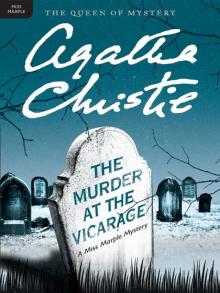 The Murder at the Vicarage (Agatha Christie Mysteries Collection)
 A Caribbean Mystery (miss marple)
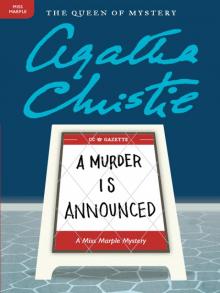 A Murder Is Announced
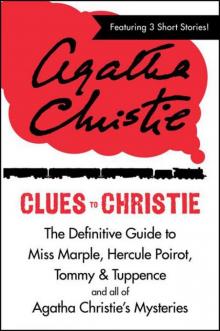 Clues to Christie
 The Moving Finger mm-3
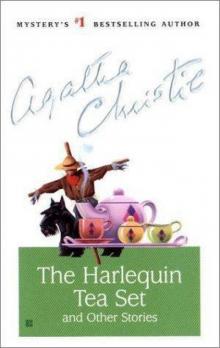 The Harlequin Tea Set and Other Stories
 Murder on the Links
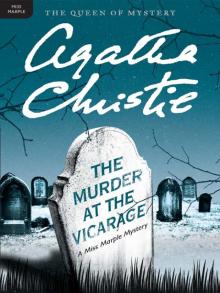 The Murder at the Vicarage
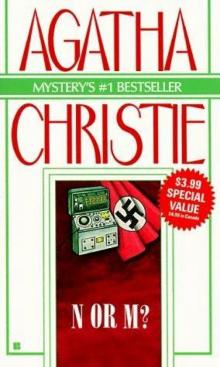 N or M tat-3
 The Secret Adversary tat-1
 The Burden
 Mrs McGinty's Dead hp-28
 Dead Man's Folly hp-31
 Peril at End House hp-8
 Complete Short Stories Of Miss Marple mm-16
 Curtain: Poirot's Last Case
 The Man in the Brown Suit
 They Do It With Mirrors mm-6